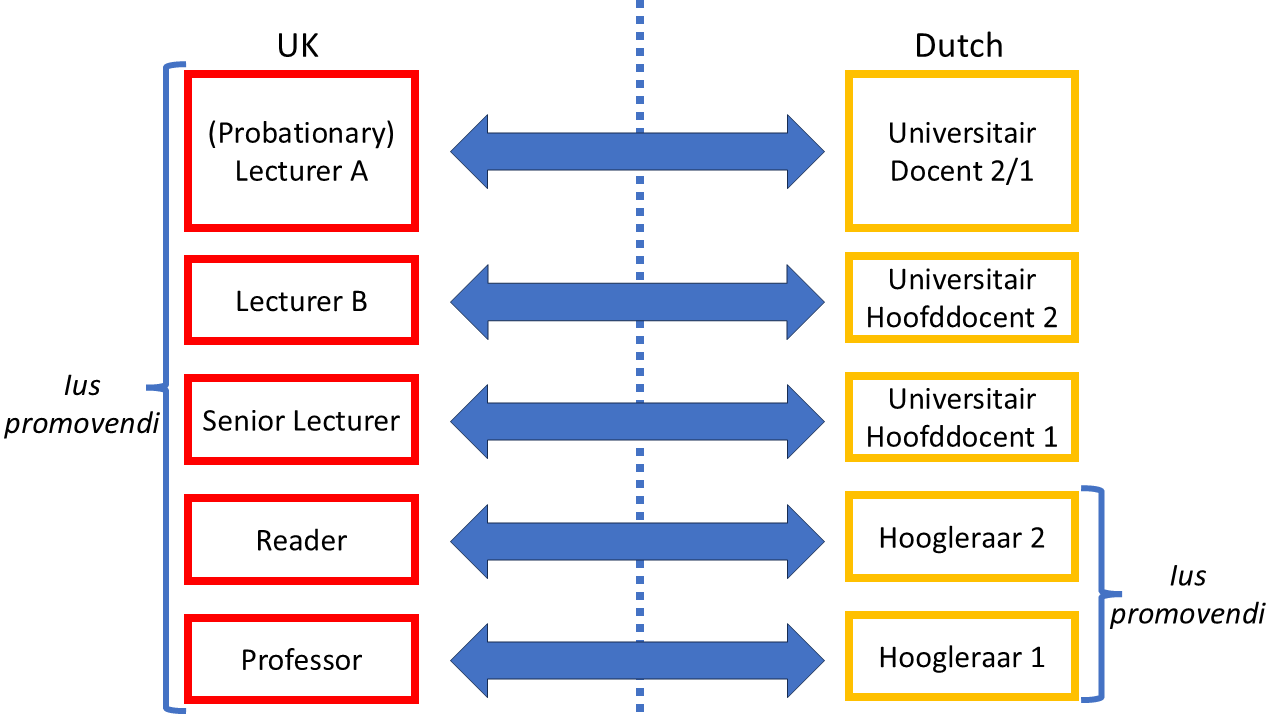
When comparing Dutch academic ranks with the UK, one runs into several issues. Firstly, British universities have largely stopped using the British ranks, and have adopted the American ones. However, it’s been implemented in an uneven manner, and the titles are no longer consistent across institutions. The second issue is that the Dutch have their own conversion to American ranks, and fit them onto the British ones. However, functionally they don’t fit.
The British ranking system of 1960’s went:
- Assistant Lecturer (became Lecturer A, on probation)
- Lecturer Below the Bar (became Lecturer A, passed probation)
- Lecturer Above the Bar (became Lecturer B)
- Senior Lecturer
- Reader
- Professor
Serials 1-3 sort of were merged into one grade, at least in titling. It was observed that the grade of assistant lecturer was effectively equated with a probationary period, and the proposal was to streamline into a probationary and passed lecturer, with probation being five (5) years in post. However, the Union successfully argued that five years was too long to be probationary, and a reduction to three years led to the split. A newly appointed academic would start at probationary lecturer A, with probation ending after three (3) years, and promotion to Lecturer B being around five (5) years in post. Many universities later conflated the two jumps into one. Lecturer B thus became the first permanent position.
Senior lecturer and Reader were considered quite separate ranks until the 1960’s, but were then placed on the same pay grade. Both have leadership positions in a department, but the difference is that a Reader has been passed as promotable to Professor. At the time, there were a limited number of Chairs for the Professors, and so promotion was slow, and it was quite nepotistic, because the promotion committees were composed of Professors in that field, and they tended to promote their own former students. Over time, more “personal chairs” were created, wherein the Universities would create a Chair specifically for someone they wished to promote to Professor, which would cease to exist when they turn it in. This has led to a recent proliferation of Professors in the UK.
In the recent Americanisation of titles, there has been no consistency in the conversions to Americanised titles, with Oxford even titling probationary lecturer A’s as “Associate Professors.” Thus no attempt can be made to convert them, and it must be done on a case-by-case basis.
The Dutch system also has six ranks for academics, and they sort of directly map over. They are:
- Universitair Docent 2 (UD2, literally University Lecturer, lower division)
- Universitair Docent 1 (UD1, ditto, upper division)
- Universitair Hoofddocent 2 (UHD2, literally Principal University Lecturer, lower division)
- Universitair Hoofddocent 1 (UHD1, ditto, upper division)
- Hoogleraar 2 (H2, literally Exalted Teacher, lower division; lowest rank allowed to use the title “Professor,” and the lowest rank historically allowed to supervise Ph.D. students)
- Hoogleraar 1 (H1, ditto, upper division)
Historically, the UD positions are in the probationary period, and they map onto Lecturer A, and have similar responsibilities. UHD2 is/was the first permanent post, and is equivalent to Lecturer B. Promotion to UHD2 is equivalent to reaching the bar; promotions to that point are basically automatic as long the minimum requirements are met (or was). UHD1 maps onto Senior Lecturer, H2 onto Reader, and H1 onto Professor.
I say historically, because in response to tightening legal contract requirements meaning the universities can’t keep people on temporary contracts for the six years of the historical tenure process, many universities now award permanent contracts after the first 18 months. However, this has led to a disconnect wherein the expected and agreed promotion to UHD2 has stopped being awarded. This is having a quite toxic effect. People with UD contracts are now taking on administration roles previous only undertaken by UHD’s and above, but without the workload rebalancing. UD’s have a 50% teaching workload, which reduces to 40% at UHD and 30% (or less) for Hoogleraren, compensating for the additional administration and leadership workload, but if you heap these responsibilities upon UD’s, then you overload them…
A wrinkle is that whilst the British system says that anybody with a Ph.D. is potentially competent to supervise and promote another Ph.D., much like how in Game of Thrones that any knight can make a knight, the Dutch system reserves this right to Hoogleraren, like the ecclesiastic laying on of hands by a bishop. UHD’s and UD’s, even if they held the grant that was paying for the student, could only be “copromoter.” However, this is breaking down in the Dutch system, and ius promovendi can now be awarded to UHD’s on application, although implementation is inconsistent.
Anyway, to the point. This is a functional equivalence chart for the historical ranks I grew up with: