I’m going to go through my papers in the order they came out, and briefly discuss them.
My first ever authorship was titled “Bioresponsive small molecule polyamines as noncytotoxic alternative to polyethylenimine” [sic, the title is grammatically incorrect as published]. The synthetic part of this work is Chris Drake‘s, as is, I think, some of the cell work (along with the second and third authors, and myself). It came out in Molecular Pharmaceutics in 2010, and currently has 27 citations. It has not been cited since 2018, as the project petered out.
Up front, I should state that my role was simply to perform additional experiments to get it over the publication line, and it is the least input I’ve had into any of my authorships. Indeed, I have ghost authorships I did much more work on. Simply, the initial submission of this paper was done lacking some data on the cytotoxicity. The reviewers came back demanding such data, but Chris had defended several years earlier (with a rare “no corrections needed”), and was working as a PDRA in the U.S. Someone needed to complete the experiments, and I was tasked. I treated the experiments as a training exercise for a fellow Ph.D. student (James Serginson), who was Chris’ replacement. He watched me perform MTT assays etc., and we were successful in getting it across the line.
At the time, I often used to run from the laboratory in South Kensington to my house in King’s Cross via several parks. On one such run my phone (an old Nokia) started ringing, and it was James. We’d been added to the paper, and did I have a middle name? Hence, my publication name became Bryn D. Monnery.
The project itself had started as a more prosaic one. The aim was to synthesise polycations that contained disulfide linkages, but no polymer could be isolated. However, it was observed the monomer controls transfected. It was hypothesised that the monomers templated onto the DNA and then oxidised in-situ to create the polymer (fig. 1). The paper says this was planned, but my recollection was that it was completely serendipitous. Sadly, the thesis remains locked in the Imperial College library, and has not been digitised.
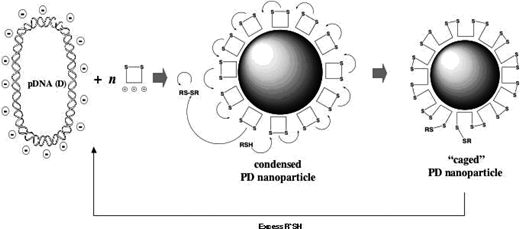
One of the interesting things about the project is that the two papers from Chris’ thesis (the second being a moderate extension of the first with a couple of extra cyclic disulfides) came out in 2010 and 2013, two and five years respectively after the thesis defence. I had a similar experience with my Ph.D.’s papers. It really caused me major problems; I moved to Belgium, and the Flemish funding agency (FWO) said I could not have a Ph.D., because Ph.D.’s were awarded by publication. I saw students there unable to defend their thesis more than five years after completing, because their PI was sitting on their papers and “too busy” to submit them. Hence I was blocked from applying for any of my own funding, and the Veni window in the Netherlands closed with only my first Ph.D. paper out, debarring me from that. That’s another discussion to be had.
The project continued under James, who never published his work. He synthesised a branched cyclic disulfide, and performed some initial tests. His thesis is interesting reading, and highlights one of the problems of the British system of extracting papers from theses rather than writing them first; often the student doesn’t write it up and their science isn’t communicated to the world.
To date, there has been no further work on this in fifteen years, and it would be interesting to reopen the study. However, the syntheses are really tricky, and took about three years for both theses.

